Somewhere along the way, “love your body” became the goal. It started as a push back against impossibly narrow beauty standards, which was a good thing. But for a lot of people, it quietly turned into one more place to fall short.
If feeling positive about your body on a hard day has ever felt out of reach, or even a little exhausting, that makes sense.
Body positivity and body neutrality often get used as if they mean the same thing, especially online. But in reality, they don’t. And the more useful question usually isn’t which one is “correct.” It’s which one actually helps you feel better in your real, day-to-day life.
Here’s a closer look at both: where each one helps, where each one can fall short, and how to figure out what fits where you are right now.

What Is Body Positivity?
Body positivity is the idea that all bodies are worthy of respect, care, and acceptance, regardless of size, shape, ability, or how closely they match a cultural ideal. Its roots trace back to the fat acceptance movement, which challenged the long-standing assumption that thinness equals worth or health.
At its core, body positivity does important work:
- It pushes back on diet culture
- It widens who gets to feel good in their own skin
- For some people, it builds genuine positive body image and body confidence (especially for those who’ve spent years being told their body was a problem to fix)
Where Body Positivity Can Fall Short
The challenge shows up when “love your body” becomes a requirement instead of an option.
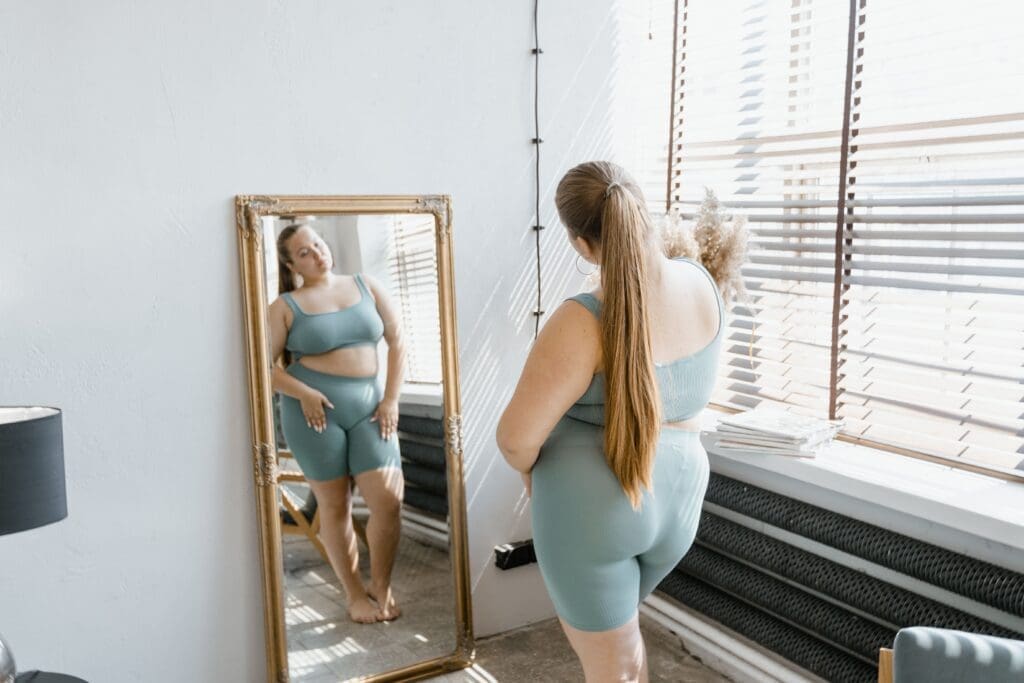
Picture someone who’s been at war with their reflection for years. They open Instagram, see a confident post about loving every inch of yourself, and feel… worse. Now they’re not just struggling with how they feel about their body, they’re also struggling with the fact that they can’t seem to love it the way they’re “supposed” to.
For someone living with negative body image, or working through a history of disordered eating, being told to feel beautiful and confident every single day can land as one more impossible standard. The bar didn’t disappear… it just moved.
It doesn’t help that body positivity has been commercialized and turned into affirmation merch, “love your body” journals, and confidence courses for sale. A message that started as radical acceptance became an expectation to like 100% of your body dressed up as freedom.
None of this means body positivity is bad. For plenty of people, it’s genuinely freeing. But it does ask something real: that you feel confident about how you look, even on days when you don’t. For someone in the middle of disordered eating recovery, or in the thick of a hard body image stretch, that ask can feel like one more thing to fail at instead of something that helps. It’s not that body positivity is wrong for these people… it’s that the timing matters.
What Is Body Neutrality?
Body neutrality offers a different starting point: your body doesn’t have to be loved to be treated with respect.
Instead of focusing on how your body looks, body neutrality shifts attention to what your body lets you do — and to noticing it without judgment at all. Your legs carried you through your day. Your arms held someone you care about. Your eyes are blue. None of that needs an opinion attached to it. Body neutrality is being able to care for your body regardless of what it looks like, and practicing language that simply describes instead of evaluates.
For a lot of people working through body confidence issues, this lands more gently. It doesn’t ask you to leap from criticism straight to adoration. It gives you permission to feel neutral about your appearance, and to spend that freed-up energy on things that matter more to you.
Body Positivity vs Body Neutrality: The Key Difference
The clearest difference between body positivity and body neutrality is the emotional ask.
Body positivity asks you to feel good about your body. Body neutrality asks you to step back from rating it at all.
One focuses on appearance and reclaiming it as beautiful (and can slide into all-or-nothing territory — “I have to love every part of my body, all the time”). The other focuses on function, care, and what your body allows in your life.
| Body Positivity | Body Neutrality | |
| The Ask | Feel good about how your body looks | Notice your body without judging it (neutral observation instead of criticism) |
| The Focus | Appearance, reclaimed as worthy | Function, care, and lived experience |
| The Win | Confidence and self-acceptance | Freedom from constant self-evaluation |
They also differ in accessibility. If you’re in the middle of real body image distress or disordered eating (not just an off day, but a place where your body feels like the enemy) “love your body” can feel like a cliff you can’t climb. “You don’t have to love it or hate it today, you just have to care for it” is often a more reachable first step. That’s usually the difference: body positivity tends to feel accessible once you have some distance from that distress; body neutrality tends to feel accessible while you’re still in it.
It helps to think of these less as opposites and more as different tools. One isn’t morally better than the other. They’re both useful in different moments, for different people.
So What Actually Helps Mental Health?
Here’s the part people most want a clean answer to: which one is better for your mental health?
The honest answer is that there’s no universal winner. What seems to matter most isn’t the philosophy you pick. It’s a handful of underlying skills that both approaches, at their best, are pointing toward.
Here are a few that stand out:
Self-Compassion
Treating yourself with the same kindness you’d offer a good friend tends to support a healthier relationship with your body far more than self-criticism ever does.
Researchers have found that people with higher self-compassion report more positive body image and fewer worries about food and shape, in part because self-compassion seems to buffer the sting of comparing yourself to others.
Body Image Flexibility
This is the ability to have a thought or feeling about your body without it hijacking your whole day or dictating your choices. Your feelings about your body can shift, and that shift doesn’t have to be a crisis.
A large review of the research links this kind of flexibility to lower levels of body image distress and disordered eating, and to higher wellbeing, intuitive eating, and self-compassion. It’s worth practicing, and it even shows up in eating disorder treatment as a meaningful predictor of how people do.
Loosening the Link Between Appearance and Self-Worth
When how you look stops being the main measure of your value, there’s suddenly a lot more room to actually live. Studies suggest that tying your worth to your appearance is connected to a more negative body image, while self-compassion helps weaken that link.
For many people, body neutrality is a more accessible on-ramp to these skills, especially when body image is in a rough place. But body positivity can be powerful too, particularly once some of that distress has eased. You don’t have to choose a side and stay there forever.
And here’s something worth holding onto, because it’s easy to get wrong: healing your body image doesn’t mean you’ll never have a negative thought about your body again.
You will. That’s normal. A negative thought about your body is going to show up sometimes, for almost everyone. It’s not a sign you’ve failed or slid backward. What actually speaks to your healing, your recovery, and your values isn’t the absence of the thought. It’s what you do with it when it arrives.
Do you spiral and let it run the day, or do you notice it, let it pass, and keep caring for yourself anyway? That response is the real measure, not some impossible standard of never struggling at all.
So if you take one thing from all of this: the goal isn’t to pick a team. It’s to spend less energy thinking about your body at all, and more on the life you’re using it to live.
How to Find the Approach That Fits You
There’s no quiz that spits out the “right” answer here. But a few gentle starting points can help you figure out what works for you.
- Meet yourself where you are, not where you think you should be. If “love your body” feels fake right now, you don’t have to force it. Neutrality might be the more honest, more sustainable place to begin.
- Notice the body-checking and the scrolling. Repeatedly checking your reflection, and feeds full of appearance-focused content, tend to keep your attention locked on how you look. Gently pulling back from those, even a little, frees up real mental space.
- Practice function over form. When a critical thought shows up, try shifting to what your body did for you today. Not to force positivity, but to widen the lens beyond appearance.
- Talk to yourself like you’d talk to a friend, and expect the process to be non-linear. You wouldn’t tell someone you love that their body is the problem, so try not to say it to yourself either. And this work rarely moves in a straight line. Better days and harder days will mix together, and that mix doesn’t mean it isn’t working. It means you’re human.
When Body Image Struggles Need More Support
Sometimes negative body image runs deeper, and it’s worth saying that plainly.
When body image distress is persistent, consuming, or tangled up with restricting, bingeing, or other disordered eating patterns, that can be a sign it’s time for more support.
Reaching out isn’t a failure, and it doesn’t mean you didn’t try hard enough on your own. It’s one of the more caring things you can do for yourself.
It’s also worth repeating that support doesn’t promise a life with zero negative thoughts about your body.
What it does is help you build the skills this whole post is about, so those thoughts have less power when they do show up. Self-compassion, flexibility, and a steadier sense of worth that doesn’t hinge on appearance are all things you can practice with help.
For more on body image, read our blog post Navigating Body Image and Food Shame in Social Settings.
You Deserve Peace Around Food and Your Body
Healing your relationship with your body isn’t a destination you arrive at one day, fully healed and never critical again. It’s a process, full of small shifts, gentle moments of self-trust, and the slow building of a new way of relating to yourself.
The goal isn’t control or perfection, it’s flexibility and peace.
Body positivity and body neutrality are both just tools, and you’re allowed to reach for whichever one helps on a given day. What matters more than the label is the direction: toward self-trust, and toward a life where your body gets to be the place you live, not the thing you spend all your energy fighting.
If you’re ready for support, our team at We All Eat Nutrition Therapy is here. We offer compassionate, weight-inclusive care for people working through food anxiety, disordered eating, body image, and everything in between.
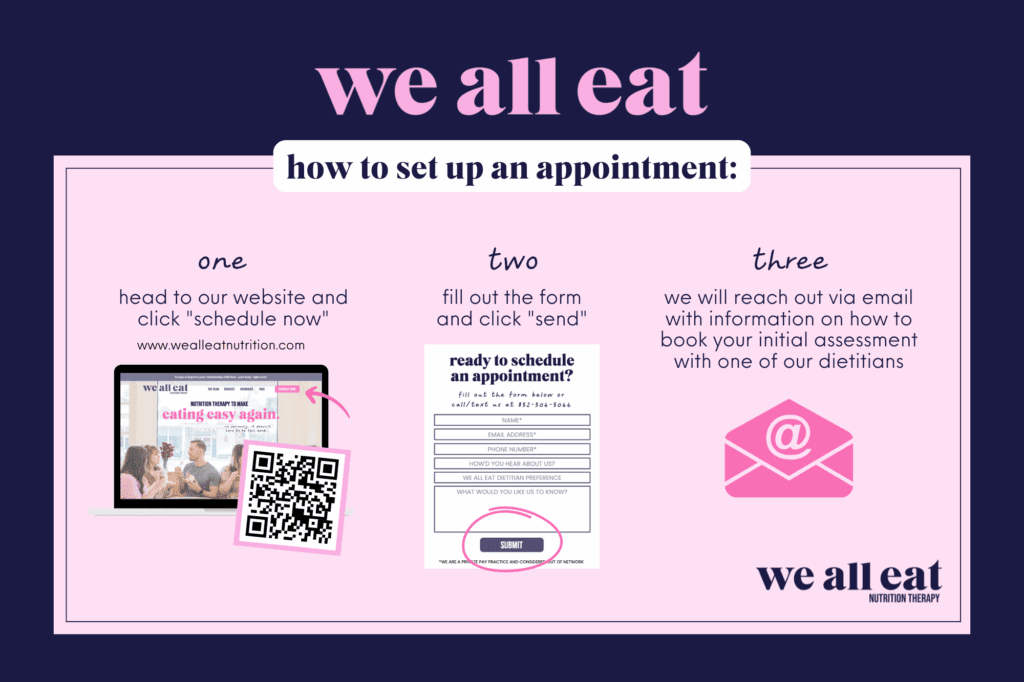
Ready to take the first step? Submit an appointment request here, we’d love to help.