Counting calories gets recommended so often that it can feel like the responsible, obvious thing to do. Tracking what you eat should make you healthier…right!?
We must first consider that counting calories isn’t a neutral health tool. It’s a diet-culture habit that pulls your attention away from your body’s signs/signals and onto a number. Oftentimes making one’s relationship with food harder, not easier.
If you’ve counted calories and ended up feeling more anxious, more preoccupied, or out of control around food, that isn’t a sign you did it wrong. It’s a sign the method itself has some real problems.
Here’s a closer look at what those problems are, and a gentler approach that’s more sustainable over time.

Why Counting Calories Feels Like the Logical Choice
It makes sense why so many people reach for calorie counting. We’re surrounded by the message that eating should be measured, earned, and tightly controlled, and that a “good” relationship with food is one where you’re always keeping track.
That’s diet culture at work. It teaches us to trust an app or a label more than our own bodies, and to treat food as a math problem to be solved rather than something to enjoy and be nourished by.
So if counting felt like the natural next step, you’re not doing anything wrong. You were handed a tool that an entire industry insists is the answer. The trouble is what that tool actually does to your thought process with food once you start using it.
The Real Problems With Counting Calories
Calorie counting runs into trouble in a few different ways. Here’s a look at what actually happens when eating becomes a numbers game.
It Pulls You Away From Your Body’s Signals
Your body is already sending you information all day long: when you’re hungry, when you’re comfortably full, when a meal feels satisfying and when it doesn’t.
Counting calories asks you to override all of that and defer to a number instead.
Over time, that external focus can drown out your internal cues. People often notice it gets harder to tell when they’re actually hungry or full, because they’ve spent so long letting an app make those calls for them.
It Turns Eating into a Full-Time Mental Job
Tracking every meal means doing math at breakfast, doing math at lunch, estimating portions at dinner, and second-guessing anything you didn’t measure.
It’s a low, constant hum of mental work that follows you through the day.
Most people don’t notice how heavy that load is until they put it down. Eating should be one of the simpler, more pleasurable parts of life, not a spreadsheet you’re never quite finished with.
The Numbers Aren’t as Accurate as They Seem
Here’s something that often gets overlooked: even on its own terms, calorie counting isn’t precise.
The figures on labels are estimates with built-in margins of error of up to 20%, and the databases inside tracking apps are based on averages, not the specific food on your plate.
On top of that, how much energy your body actually takes in from a given food varies based on things like how it’s cooked and how your own digestion works.
So even when you’re tracking carefully, you’re chasing a number that was never exact to begin with, and this makes all that effort even harder to justify.
It Creates Food Rules That Are Hard to Live With
Once you’re calorie counting, foods start to fall into “worth it” and “not worth it” piles. You build up a quiet rulebook about what foods are allowed, when you can eat them, and how much is okay.
These food rules can feel structured and safe at first. But rigid limits tend to set up an all-or-nothing dynamic, where one “off-plan” choice can feel like the whole day is ruined.
That pattern is exhausting, and it has very little to do with actual nourishment.
Food Restriction Tends to Backfire
This is the big one. When you restrict food, whether by cutting types of food out or capping how much you eat, your body and brain respond by turning up the mental volume on those foods.
Specific foods (or all foods) become harder to stop thinking about, not easier.
That’s why so many people find themselves swinging between strict control and feeling out of control around food.
A number on an app can tell you a lot of things. What it can’t tell you is whether you feel nourished, satisfied, calm, and at peace around food, and those are the things that actually point to a healthy relationship with eating.
If that cycle feels familiar, you might find our blog post Understanding the Restrict-Binge Cycle: Why It’s Not About Willpower helpful. It breaks down exactly why this happens and why it was never about discipline in the first place.

Intuitive Eating vs. Dieting: A Different Starting Point
When people compare intuitive eating vs dieting, they often assume intuitive eating is just a looser set of rules. But it’s actually a different foundation entirely.
Dieting starts from distrust. The underlying message is that your body can’t be trusted, so you need external rules, such as calorie targets, plans, and lists of approved foods, to keep it in line.
Because those rules tend to break down over time, dieting often leaves people feeling like they failed, when really the approach failed them.
Intuitive eating starts from curiosity and trust. Instead of asking “what am I allowed?” it asks “what do I actually want and need right now?”
It rebuilds your connection to hunger, fullness, and satisfaction, and it treats your body as a partner rather than a problem to manage.
That’s why this isn’t about swapping one rulebook for a gentler one. It’s about stepping off the rulebook entirely and learning to trust yourself again.
To learn more about intuitive eating, read our blog post What is Intuitive Eating? A Gentle Guide for Breaking Free from Dieting.
What to Do Instead of Counting Calories
So if you’re not counting, what are you doing? This is where gentle nutrition comes in: caring about how food makes you feel without scoring, ranking, or tracking it.
Here are a few of the places people tend to begin:
- Pay attention to how food affects you. Notice your energy, your fullness, your mood, and how satisfied a meal leaves you. These tell you far more than any total ever could.
- Let all foods have a place. When no food is off-limits, foods tend to lose the intense pull that restriction gives them. Permission is often what calms the chaos and eases your food decisions.
- Add in rather than cut out. Instead of focusing on what to remove, think about what might be nice to include, such as more variety, more satisfaction, and more foods you actually enjoy.
- Reconnect with hunger and fullness slowly. After a long time of overriding these signals, they can take a while to come back. Meeting that process with patience and self-compassion matters more than getting it “right.”
Note that this is not a checklist to perfect, just a different direction to move in.
This kind of eating won’t give you the tidy sense of control that counting calories promises. What it offers instead is something more sustainable: a way of eating that fits your real life and doesn’t ask you to ruminate about food all day.

Frequently Asked Questions About Counting Calories
Is counting calories bad for you?
Counting calories isn’t risky for everyone, but it carries real downsides. For many people it increases food anxiety, weakens their ability to read hunger and fullness, and reinforces the belief that eating has to be earned or controlled.
If tracking has ever left you more preoccupied with food rather than less, that’s worth paying attention to.
What can I do instead of counting calories?
A gentler alternative is to notice how food actually affects you (your energy, fullness, satisfaction, and mood) instead of scoring it. This approach, often called gentle nutrition, lets you care about and focus on nourishment without turning every meal into a math problem.
Is intuitive eating better than dieting?
Outside of a medically necessary dietary restriction, yes. Dieting relies on external rules and tends to break down over time, while intuitive eating rebuilds trust in your body’s own signals.
It’s less a quick fix and more so a lasting shift in how you relate to food.
How do I stop thinking about calories all the time?
Constant calorie thoughts often ease as you step away from tracking and slowly rebuild trust with your body, though it rarely happens overnight, especially after counting for a long time.
Reducing your exposure to diet-culture content and working with a non-diet dietitian can make the process feel a lot less lonely.
You Deserve Peace Around Food
Letting go of calorie counting can feel uncomfortable at first, even a little scary. After relying on numbers for a long time, trusting your body again takes practice, and there will be wobbles along the way.
Remember that this is part of the process, not a sign it isn’t working.
If food is taking up a lot of mental space, or that restrict-and-control cycle feels hard to step out of on your own, that’s a reasonable moment to reach for support.
Reaching out isn’t a failure. It’s one of the more caring things you can do for yourself.
At We All Eat Nutrition Therapy, we offer compassionate, weight-inclusive care for people working through food anxiety, restriction, disordered eating, and everything in between.
No food rules, no shame, no numbers to hit; just real support for building a relationship with food that feels peaceful instead of stressful.
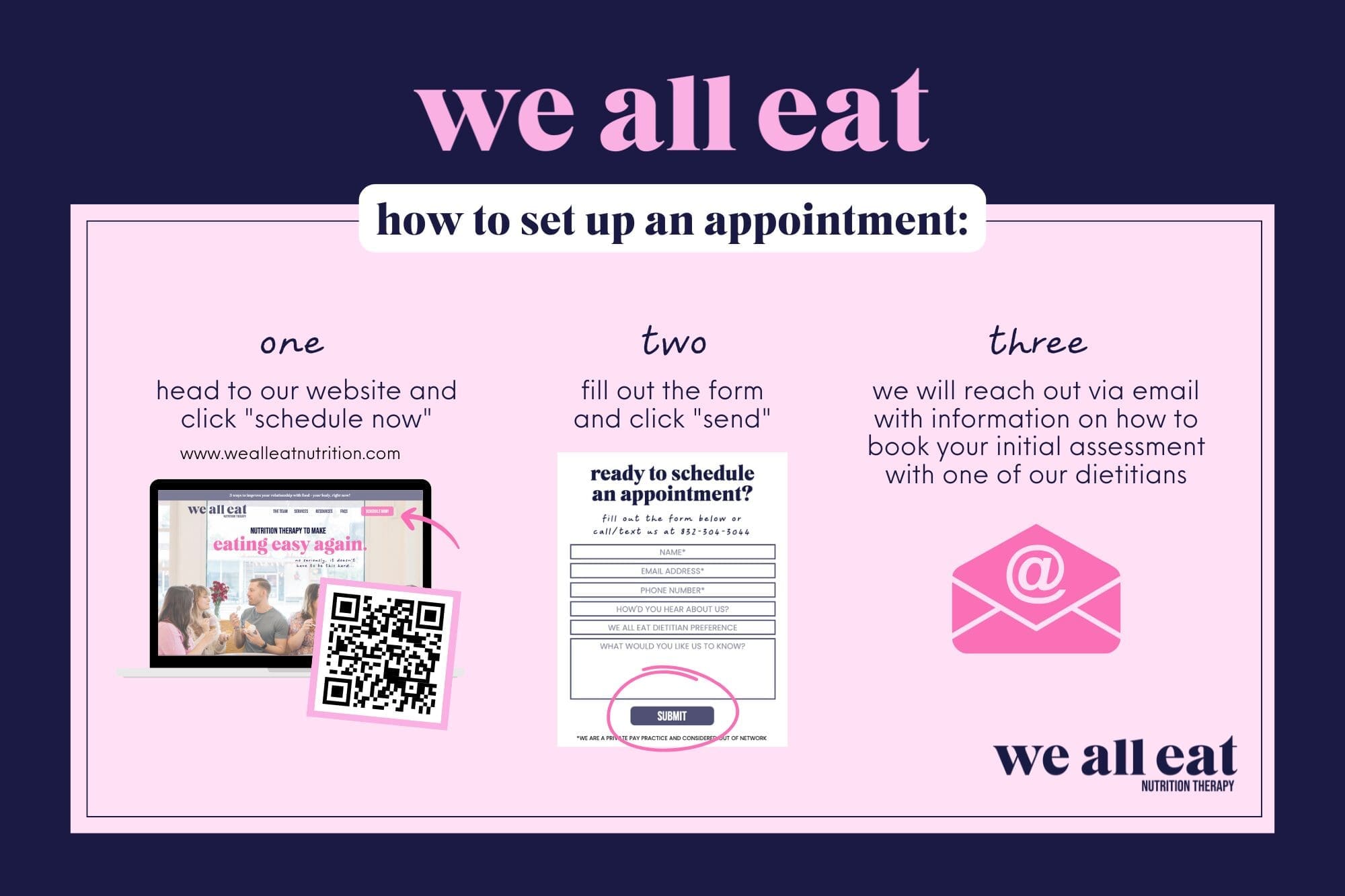
Ready to take the first step? Submit an appointment request here, we’d love to help.