
For many people, social settings bring more than just small talk and shared meals. They can also bring up deep-rooted body image issues and food shame.
Whether you’re sitting around a table with extended family, catching up with friends at a birthday party, or attending a work event with catered meals, these environments can highlight insecurities and trigger anxiety around how you look, what you’re eating, and what others might think.
If you’ve ever felt self-conscious about your body in social spaces or judged for your food choices in front of others, you’re not alone.
Let’s unpack why this happens and how you can navigate these experiences with more peace and self-compassion.

Why Social Settings Can Trigger Body Image Struggles
Social events often come with subtle (and not-so-subtle) expectations about appearance. Whether it’s comments about who’s “lost weight,” what someone’s wearing, or how much someone is eating, there’s often a magnifying glass placed on bodies and behavior.
Here’s why bad body image can feel especially intense in social settings:
- Comparison is everywhere. It’s natural to scan the room and compare yourself to others, especially when you don’t feel confident in your body.
- Food becomes a mirror. When others are watching or commenting on what you’re eating (or not eating), it’s often a reflection of their own issues with food than anything to do with your eating habits.
- Old wounds get reopened. If you’ve received negative body feedback from others in the past, those memories can resurface even years later and make you nervous about how to respond if you were experienced more.
Body image refers to the way you perceive and feel about your body. When that image is shaped by outside expectations and unrealistic beauty standards, it can become difficult to feel safe and confident in your own skin, especially in social situations.
How Body Image Issues Contribute to Food Guilt
Body image issues and food guilt often go hand-in-hand. When you feel uncomfortable in your body, it can affect not only how you eat, but also how harshly you judge yourself for eating, often as part of trying to control your body size.
You might notice patterns like:
- Restricting before social events to “make up” for what you’ll eat later
- Overeating at events and then feeling guilt or regret afterward
- Mentally tracking everything you eat and trying to “undo” it later with exercise or restriction
These patterns are often misunderstood as discipline problems—but they’re actually signals of deeper distress.
When your self-worth feels tied to your body, your food choices start to feel like moral decisions. And when food becomes a source of guilt, it’s even harder to care for yourself in compassionate ways.

Scripts to Handle Body Negativity and Food Comments
One of the hardest parts of social spaces is dealing with body negativity, especially when it comes from people you know.
Even well-meaning comments about your body or food can leave you feeling exposed or judged.
Here are a few examples of what you might hear—and simple ways to respond if you feel comfortable:
Comment: “You’ve lost weight! You look great!”
Response: “Thanks, but I’m focusing more on how I feel than how I look lately.”
Comment: “Are you sure you want seconds?”
Response: “Yep—still hungry and listening to my body today.”
Comment: “You’re being so good skipping dessert!”
Response: “I try not to think of food as good or bad anymore—it’s just food, and I’m not hungry for dessert. Maybe I will have some later!”
You don’t have to respond to every comment. Setting internal boundaries, and reminding yourself that others’ opinions don’t define your worth, can be just as powerful.
Body Positivity vs. Body Neutrality: Setting Boundaries and Intentions That Reflect Your Values
You don’t have to love your body every day to treat it with respect.
In fact, the pressure of body positivity, to feel confident and joyful in your appearance all the time, can feel overwhelming when you’re struggling.
That’s where body neutrality comes in. It offers permission to shift the focus from how your body looks to how your body functions and how you treat it.
Ask yourself:
- What boundaries would help me feel safe or grounded in this setting?
- How do I want to speak to myself today?
- What really matters to me in this space… my appearance, or my presence?
Setting boundaries with others and with yourself isn’t about being harsh—it’s about choosing peace over pressure. You deserve to move through social spaces without constantly self-monitoring your body or policing your food choices.
Coping Tools to Build Body Trust in Social Settings
When you’ve spent years fighting with your body, learning to trust it again can feel foreign—but it’s possible. And you don’t have to get it perfect to see progress!
Here are a few tools to help you build body trust in social spaces:
Before the Event:
- Set a grounding intention (for example, “I want to stay connected to myself today”)
- Practice self-compassion with affirmations or deep breathing
- Wear something that feels physically comfortable and you feel confident in
During the Event:
- Pause to check in with your hunger, fullness, and emotional state
- Give yourself permission to eat what feels good without justification
- Take breaks—step away, go to the bathroom, or get a breath of fresh air to give yourself space and reconnect with your body’s cues
After the Event:
- Reflect: What felt hard? What helped? What went well?
- Offer yourself kindness if it didn’t go as planned
- Reach out for support if needed
The more you practice tuning into your body, the more your internal voice of compassion can override the external noise.
If you’ve ever left a social event feeling defeated by bad body image or drowning in food guilt, you are far from alone.
And more importantly—you are not the problem. The expectations placed on your body, your appearance, and your plate are the problem.
You don’t need to earn your place at the table. You don’t need to justify your hunger. You don’t need to feel confident in your body all the time to treat it with care.
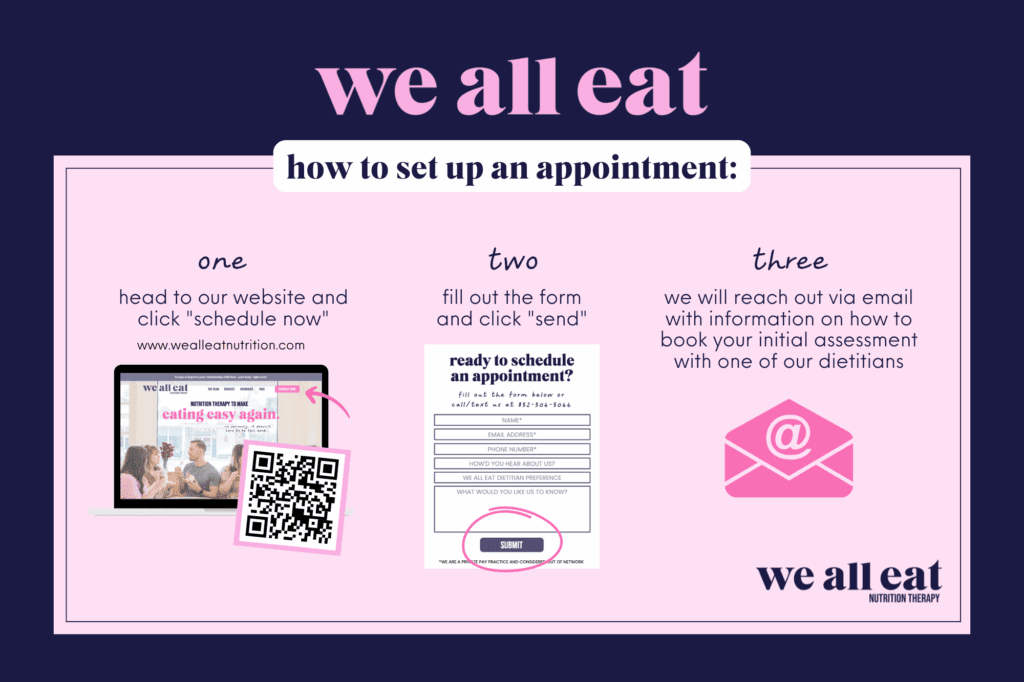
What you do need is space, support, and compassion—and if you’re ready to take the next step toward a more peaceful relationship with food and your body, the We All Eat Nutrition Therapy team is here to help.
📅 Book a session with one of our non-diet dietitians here or call/text 832-304-3044 and we’ll help you take the first step.
You deserve support that honors your whole self.

